
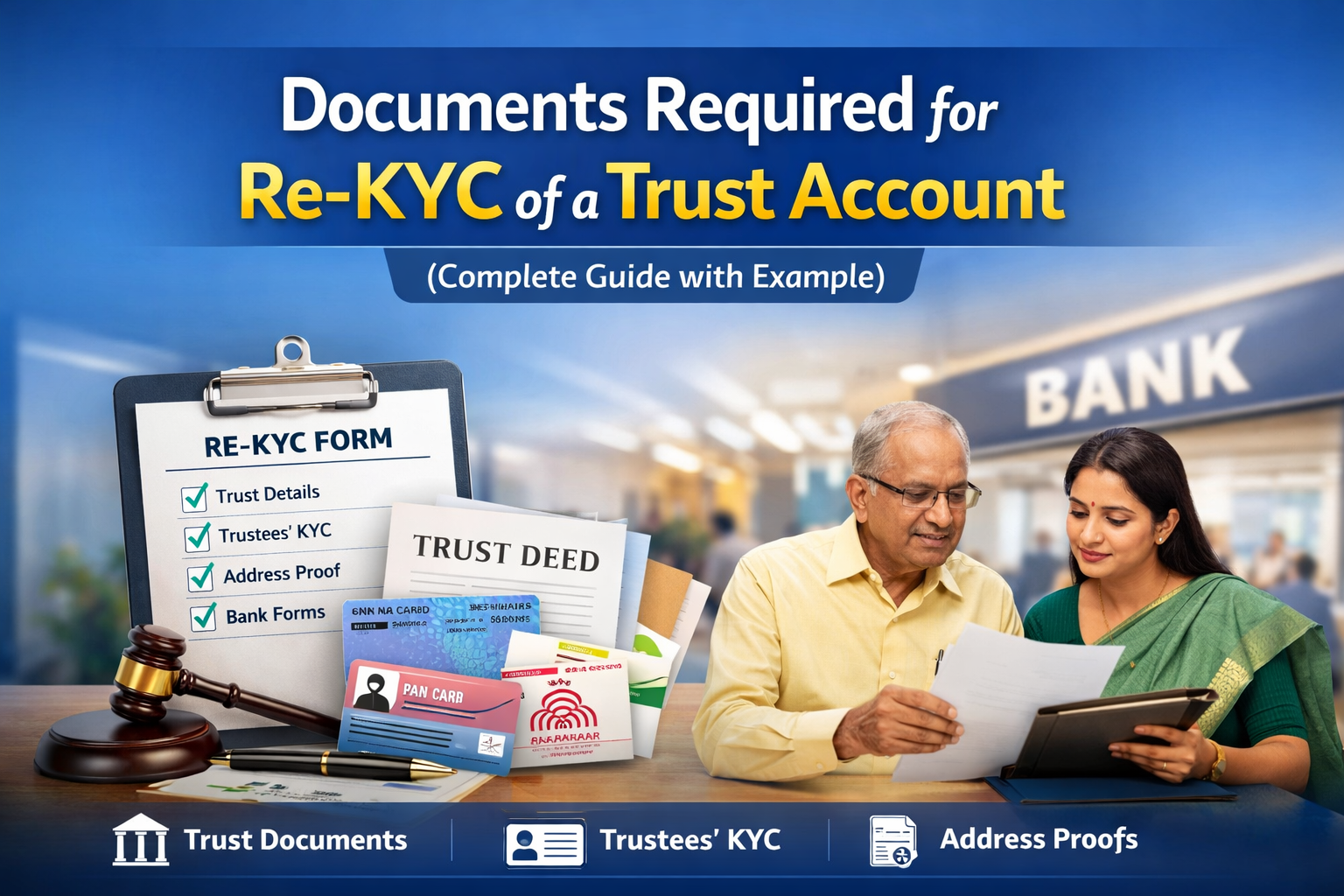
If you are operating a trust account in a bank, you may sometimes receive a message asking you to complete Re-KYC (Re-Know Your Customer). Many trustees feel worried or confused when they see such notifications, but the process is actually simple.
Banks ask for Re-KYC to update customer information as per guidelines issued by the Reserve Bank of India. It is a routine compliance requirement and does not indicate any problem with your account.
Why Re-KYC is Important for Trust Accounts
Re-KYC helps banks:
Verify trustees and authorized signatories
Update address and contact details
Confirm the trust is active and operational
Prevent fraud or misuse
Follow regulatory compliance
If Re-KYC is not completed on time, the bank may restrict debit transactions temporarily.
Documents Required for Trust Re-KYC
Most banks, including YES Bank and other private or public sector banks, usually ask for the following documents:
- Trust Documents
Registered Trust Deed (latest copy)
PAN Card of the Trust
Trust Registration Certificate (if applicable)
List of Trustees on trust letterhead
Trustee Resolution for authorized signatory - KYC of Trustees / Authorized Signatories
For each trustee or authorized person:
PAN Card (mandatory)
Aadhaar Card / Passport / Voter ID / Driving License
Address proof (if different)
Passport size photograph
Mobile number and email ID - Address Proof of Trust
Any one document:
Electricity bill
Telephone bill
Property tax receipt
Rent agreement (if rented premises)
(Usually not older than 2–3 months) - Bank Forms
Re-KYC form provided by bank
FATCA/CRS declaration (if required)
Signature update form (if needed)
Real-Life Example
Let’s understand this with a practical example.
Jain Sons & Father Trust had a savings account in a private bank for many years. One day, the trustee received an SMS stating that the account would be restricted if Re-KYC was not completed within 30 days.
Initially, the trustees were worried because they thought the account had some issue. After visiting the branch, the bank officer explained that it was a routine update process.
They submitted:
Trust deed copy
PAN of the trust
Aadhaar and PAN of trustees
Electricity bill of the trust office
Trustee authorization resolution
Within 3 working days, the bank updated the KYC successfully, and the account continued operating normally without any restriction.
This example shows that Re-KYC is usually quick if documents are ready.
Step-by-Step Process to Complete Re-KYC
Visit your bank branch.
Collect and fill the Re-KYC form.
Attach self-attested documents.
Show original documents for verification.
Trustees sign wherever required.
Bank processes the update in a few days.
Important Tips to Avoid Problems
Ensure names match PAN records
Provide clear photocopies
Inform bank if trustees changed
Carry originals during submission
Complete before the deadline
What Happens If You Ignore Re-KYC?
If you do not complete Re-KYC:
Debit transactions may stop
Cheques may be returned
Net banking may be blocked
Account may become partially frozen
So it is always better to complete it on time.
Final Words
Re-KYC for a trust account is not complicated. Once documents are arranged, the process usually takes only a few days. Keeping records updated ensures smooth banking operations and avoids unnecessary stress.