
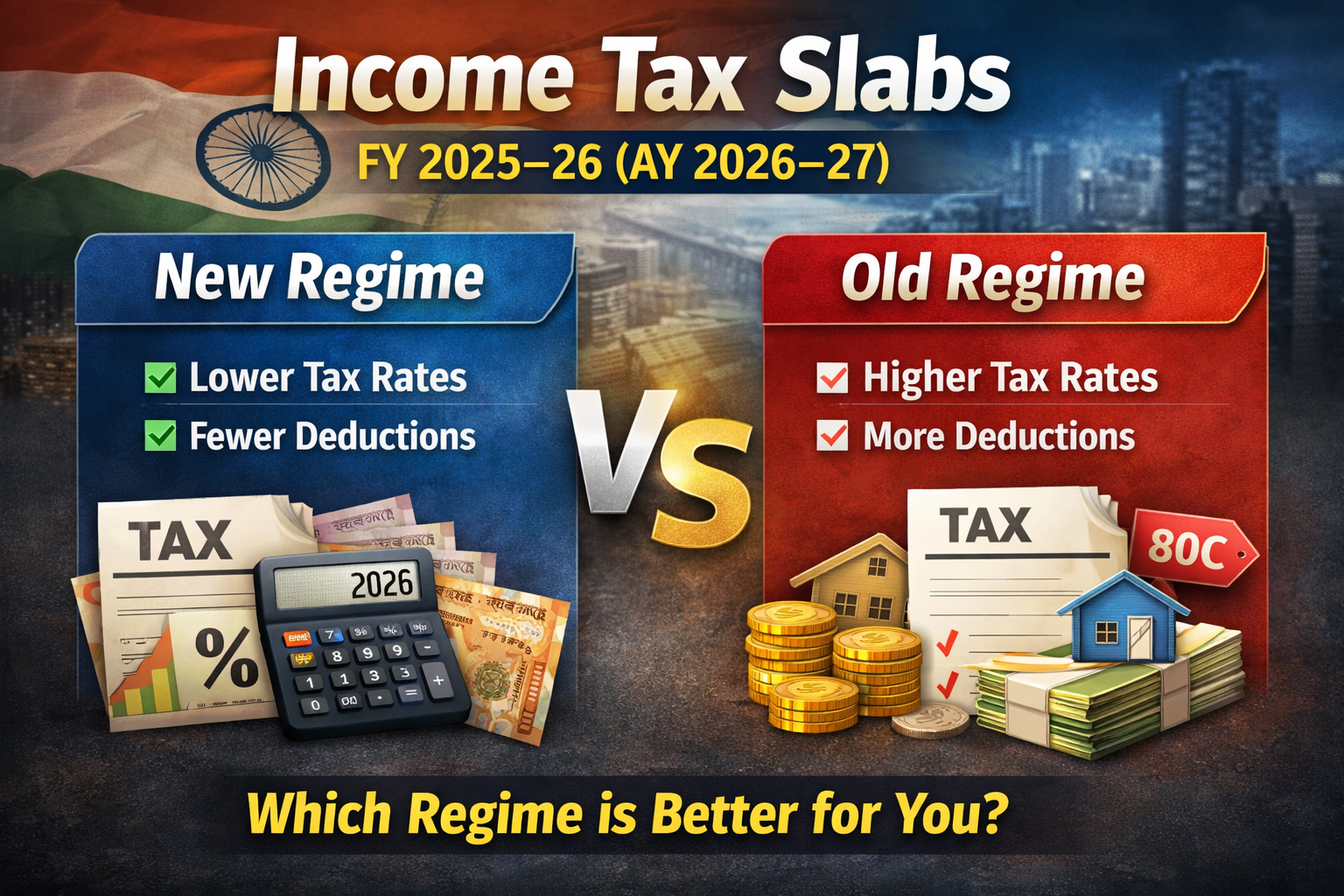
The Indian income tax system currently offers two options for taxpayers. These are the New Tax Regime, which is the default option, and the Old Tax Regime, which taxpayers can choose voluntarily.
According to the announcements made in Budget 2026, the income tax slab structure remains the same as the previous financial year. Taxpayers can select the regime that suits their financial planning and deductions.
This guide explains the current income tax rates and the key differences between the new and old tax regimes.
New Tax Regime (Default System)
The new tax regime has become the default taxation system for individuals. It provides lower tax rates, but most deductions and exemptions are not allowed under this system.
Income Tax Slabs – New Regime
| Annual Income | Tax Rate |
|---|---|
| Up to ₹4,00,000 | No tax |
| ₹4,00,001 – ₹8,00,000 | 5% |
| ₹8,00,001 – ₹12,00,000 | 10% |
| ₹12,00,001 – ₹16,00,000 | 15% |
| ₹16,00,001 – ₹20,00,000 | 20% |
| ₹20,00,001 – ₹24,00,000 | 25% |
| Above ₹24,00,000 | 30% |
Key Highlights
- This regime is automatically applied when filing income tax returns unless the taxpayer selects the old system.
- It offers simplified tax filing with fewer calculations.
- Most tax-saving deductions and exemptions are not available.
- Under Section 87A, eligible taxpayers may receive a rebate that can reduce the tax liability to zero for income up to about ₹12 lakh, depending on certain conditions.
Old Tax Regime (Optional System)
The old tax regime follows the traditional tax structure and allows taxpayers to claim several deductions and exemptions.
Income Tax Slabs – Old Regime
| Annual Income | Tax Rate |
|---|---|
| Up to ₹2,50,000 | No tax |
| ₹2,50,001 – ₹5,00,000 | 5% |
| ₹5,00,001 – ₹10,00,000 | 20% |
| Above ₹10,00,000 | 30% |
Main Advantages
The old regime allows deductions such as:
- Section 80C investments like PPF, ELSS, and LIC
- House Rent Allowance (HRA)
- Home loan interest deduction
- Health insurance premium deduction under Section 80D
- Other tax exemptions available under the Income Tax Act
Because of these deductions, this regime may be suitable for people who actively invest in tax-saving options.
Comparison Between New and Old Tax Regimes
| Feature | New Tax Regime | Old Tax Regime |
|---|---|---|
| Default system | Yes | No |
| Tax rates | Lower | Higher |
| Deductions allowed | Limited | Many deductions available |
| Filing complexity | Simple | Slightly more complex |
| Best suited for | People with fewer investments | People claiming multiple deductions |
Which Tax Regime Is Better?
The choice between the two regimes depends on your income and tax-saving investments.
You may prefer the new tax regime if:
- You do not claim many deductions.
- You want a simple tax filing process.
- Your investments in tax-saving instruments are limited.
The old tax regime might be better if:
- You regularly invest in tax-saving schemes.
- You claim deductions such as HRA, insurance premiums, or home loan interest.
Final Thoughts
India currently provides taxpayers with the flexibility to choose between two tax systems. The new tax regime focuses on simplicity with lower tax rates, while the old regime provides several deductions that can help reduce taxable income.
Since Budget 2026 has not introduced any changes to the tax slabs, the same rates will apply for Financial Year 2025–26 (Assessment Year 2026–27).
Before submitting your income tax return, it is wise to compare both regimes and select the one that results in lower tax liability.