
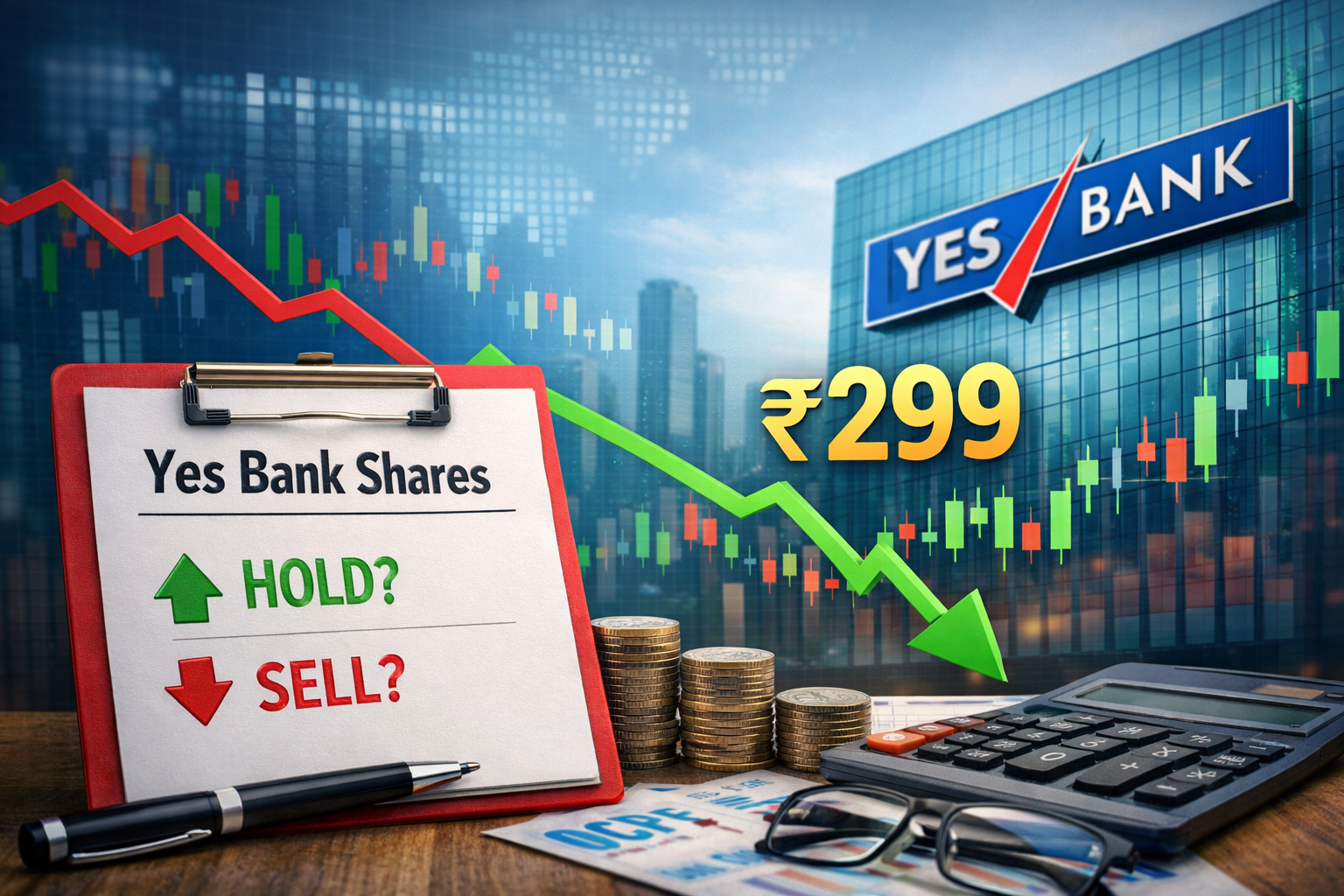
Many investors in India still hold shares of Yes Bank that were purchased years ago at much higher prices. If you are holding 5098 shares at an average price of ₹299, it is completely natural to feel confused about what to do next. Should you sell the shares and accept the loss, or wait and hope the price rises again?
Situations like this are common in the stock market. Investors often buy shares during strong market phases and later see prices fall sharply. The important thing is to make a calm, practical decision rather than reacting emotionally.
In this article, we will look at the situation from a realistic perspective to help you decide whether holding or selling your shares could be the better option.
A Quick Look at the Bank’s Journey
A few years ago, Yes Bank was considered one of the fastest-growing private sector banks in India. The bank expanded rapidly and attracted many investors who believed it would become one of the country’s leading financial institutions.
However, the bank later faced serious financial problems. Rising bad loans, governance issues, and liquidity concerns created a major crisis. The situation became so serious that regulators had to intervene.
To stabilize the bank, the Reserve Bank of India introduced a reconstruction plan. Several large financial institutions, including the State Bank of India, invested in the bank to restore confidence and prevent collapse.
Although the bank survived and continues to operate normally today, its share price never recovered to the earlier levels.
Your Investment Position
Let us understand your investment in numbers.
- Number of shares: 5098
- Average purchase price: ₹299
- Total investment: Approximately ₹15.24 lakh
Since the current market price is far below ₹299, your investment is currently showing a large loss on paper.
However, it is important to remember that this loss becomes real only if you decide to sell the shares.
Can the Share Price Return to ₹299?
One of the most common questions investors ask is whether the share price can return to its previous levels.
While it is not impossible, it could take many years for such a recovery, and there is no guarantee that it will happen. Stock prices depend on several factors, such as:
- Profit growth
- Asset quality improvement
- Investor confidence
- Banking sector performance
- Overall market conditions
Even if the bank improves financially, the stock may move upward slowly rather than quickly.
Reasons You Might Consider Holding the Shares
There are a few situations where holding your shares could make sense.
Long-Term Investment Perspective
If you are a long-term investor and do not urgently need the money, you may choose to hold the shares and observe the bank’s progress over the next few years.
The Bank Has Stabilized
The bank is no longer in crisis mode. Management has been working to improve asset quality, strengthen operations, and rebuild trust among investors.
If these efforts continue successfully, the share price may gradually improve over time.
Avoid Booking Immediate Loss
Selling now means accepting a large loss. Some investors prefer to hold their shares rather than locking in a loss immediately.
Reasons You Might Consider Selling
Selling the shares may also be a sensible decision in certain situations.
Opportunity Cost
Money that remains invested in a slow-moving stock cannot be used for other investments that may grow faster. Holding such shares for many years could mean missing better opportunities in stronger companies or diversified funds.
Portfolio Diversification
Investing too much money in a single stock increases risk. A diversified investment portfolio can help reduce financial uncertainty.
Realistic Recovery Expectations
Some investors hold a stock for many years, hoping it will return to the purchase price. In reality, markets do not always behave that way. Sometimes it is better to accept the loss and focus on better opportunities.
A Balanced Strategy Many Investors Use
Instead of making an extreme decision, many experienced investors follow a balanced strategy.
They may:
- Sell a portion of their shares to recover some capital
- Continue holding the remaining shares for potential long-term recovery
- Reinvest the recovered money into stronger companies or diversified mutual funds
This approach reduces risk while still allowing some exposure to possible future gains.
Important Lessons for Investors
Experiences like this can teach valuable lessons about investing.
Diversification is essential. Avoid investing a large portion of your savings in a single stock.
Focus on fundamentals. Companies with strong financial health and stable management tend to perform better in the long run.
Control emotions. Fear and hope can influence decisions, but long-term investing requires patience and discipline.
Final Thoughts
If you are holding 5098 shares at ₹299, the decision to sell or hold depends on your financial goals, risk tolerance, and investment timeline.
The bank has survived its earlier crisis and continues operating, but a return to previous price levels may take significant time. Some investors may choose to wait patiently, while others may prefer to exit and reinvest in stronger opportunities.
The best approach is to evaluate your overall financial situation and make a decision that supports your long-term financial stability.